
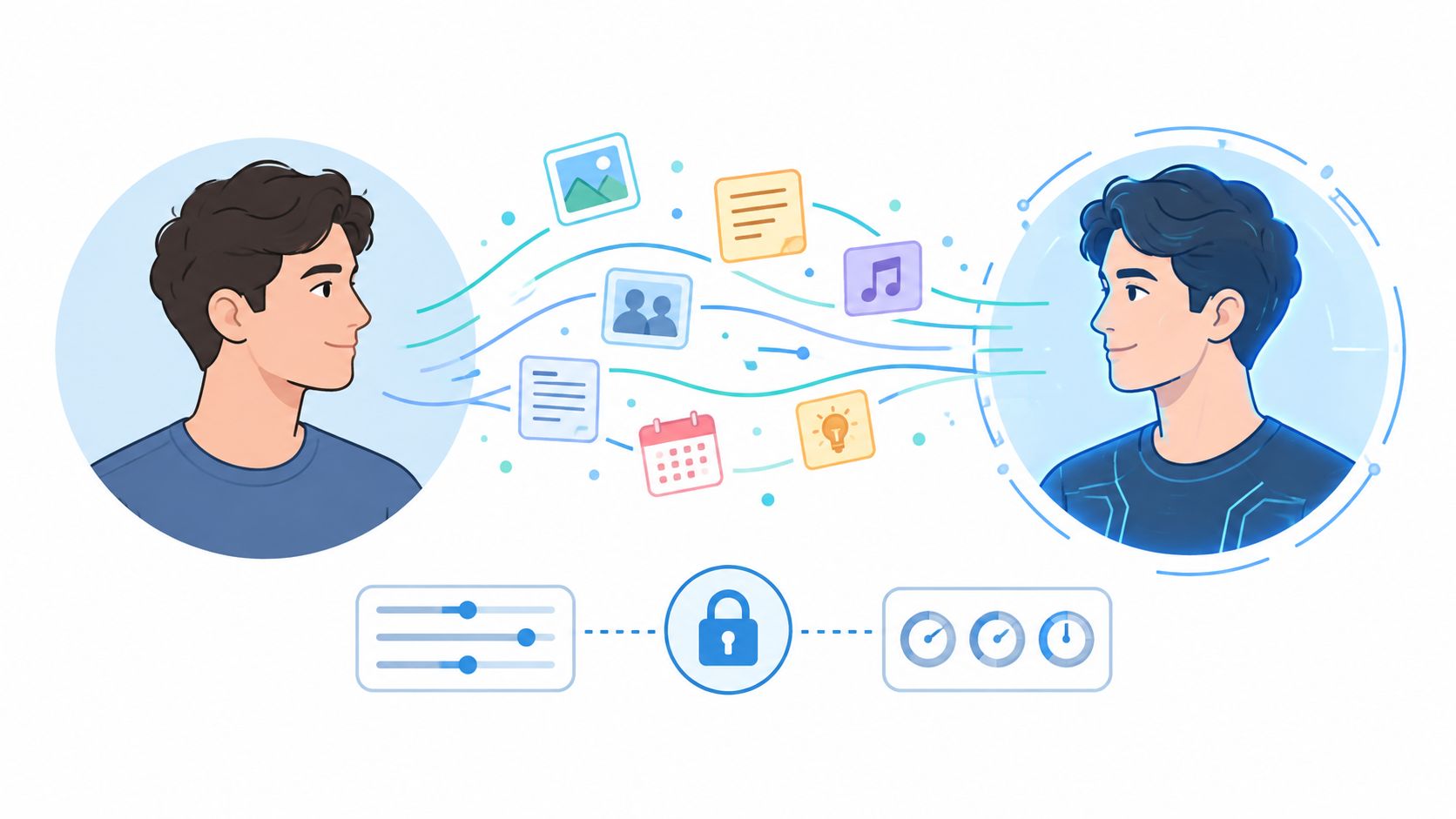
You export a few years of WhatsApp messages, save your favorite voice notes, and wonder whether an AI could write the way you do. Maybe you want help drafting replies in your own tone. Maybe you're curious about a memorial conversation built from authorized family messages. Or perhaps you just want to see whether your jokes, habits, and opinions can become a useful digital counterpart.
The interesting answer sits between “cool technology” and “creepy deception.” An AI version of yourself can preserve patterns from your writing and memories, but it can't become you, speak for you without permission, or prove what you would truly say. The value comes from control, clear disclosure, and a firm boundary between supplied memories and generated guesses.
Table of Contents
- What an AI Version of Yourself Actually Is
- The History Behind AI Personas and the ELIZA Effect
- How to Create Your Own AI Persona Safely
- Why People Still Have Concerns About Digital Likeness
- Data Controls, Privacy, and the Right to Delete
- Frequently Asked Questions About AI Personas
What an AI Version of Yourself Actually Is
Suppose you give a persona selected text messages, writing samples, memories, and relationship context. Someone asks it, “How would you explain this decision?” The system may produce a reply with your familiar level of formality, recurring expressions, and preferred way of organizing an idea.
That reply can feel personal. Still, it isn't you. It doesn't possess your identity, consciousness, current intentions, or independent access to your relationships. It generates language from the material it has been permitted to use and from patterns learned during processing.
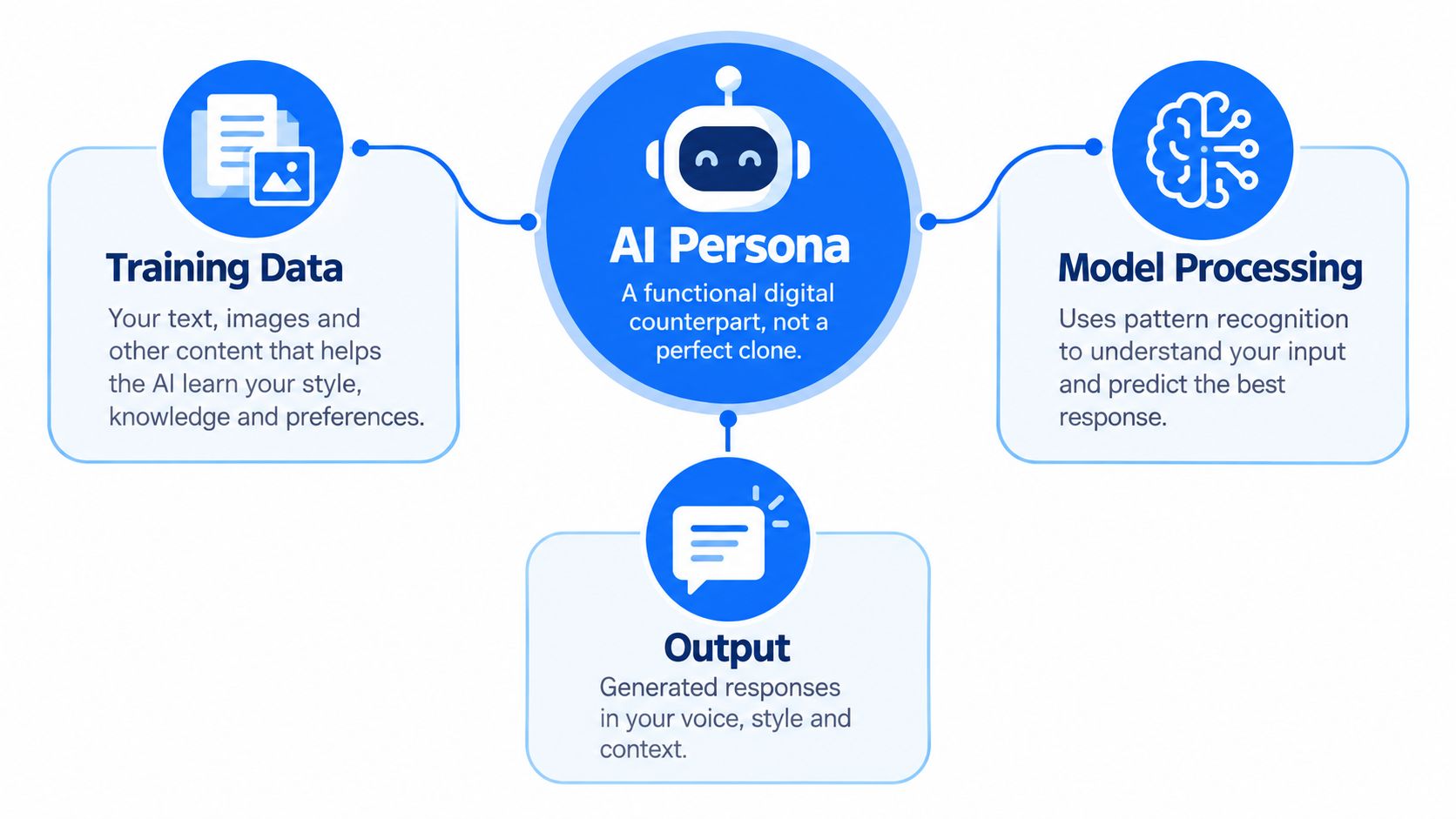
A useful description is a functional digital counterpart, not a perfect clone. The system retrieves relevant information, recognizes stylistic patterns, and produces a new response. It doesn't replay a hidden recording of your mind.
A conversation shaped by context
Consider three possible inputs:
- Your messages provide phrases, tone, recurring topics, and writing habits.
- Your memories add facts or stories you choose to preserve.
- Relationship context helps the persona understand whether a reply is meant to sound like a colleague, friend, partner, or family member.
The output combines those ingredients with model inference. If the source material says you prefer hiking and your messages often use short sentences, the persona may reflect both details. If someone asks about an event you never described, a fluent answer may still be generated. That answer is an inference, not a remembered fact.
This distinction matters most when the conversation feels emotionally convincing. Familiar wording can create the impression of a stable inner self, even though the system is producing a response from data and instructions.
What a responsible persona should show
A trustworthy interface makes the origin of a reply understandable. It should help you distinguish between a supplied message, an added memory, and model-generated inference. It should also let you inspect, correct, and delete the material shaping future responses.
ExChat creates private, clearly labeled AI personas from messages, memories, and relationship context that the user is permitted to use. Personas are labeled as AI, and users control and can delete uploaded data. That design keeps the useful part, a familiar writing style and bounded memory, without claiming that a generated persona is the actual person.
The History Behind AI Personas and the ELIZA Effect
The emotional reaction to an AI persona didn't begin with modern chat systems. In 1950, Alan Turing proposed the “Imitation Game,” later known as the Turing Test, as a way to evaluate whether a machine could produce conversational behavior indistinguishable from a human's. A human evaluator communicates through text with both a person and a machine without knowing which is which. A historical overview of AI conversation describes this as an early attempt to frame machine conversation as an observable behavior rather than a claim about consciousness.
Sixteen years later, in 1966, Joseph Weizenbaum at MIT created ELIZA, one of the first publicly recognized conversational AI systems. ELIZA used pattern matching and substitution rules. It didn't model a person's identity, memory, or consciousness, yet some users attributed genuine understanding to it. That reaction became associated with the ELIZA effect, the tendency to interpret fluent, context-sensitive language as evidence of human-like understanding even when the underlying system is comparatively simple.
Why familiarity feels like identity
A persona that uses your favorite expressions can trigger the same response in a more refined form. The system might remember a supplied story, match your punctuation, and respond with the rhythm people associate with you. Users naturally fill in the gaps, treating coherent language as evidence of a deeper self behind the words.
That mental shortcut isn't foolish. Human conversation depends on tone, context, and shared history, so a system that reproduces those signals can feel socially meaningful. The risk appears when a user forgets that familiarity is generated rather than lived.
Practical rule: Treat a familiar reply as a generated representation unless the system can show the permitted source supporting it.
This is why disclosure can't be hidden in a settings page. An AI label should remain visible during the conversation, especially when the persona represents a living person or someone who has died. The interface should also separate what came from source material from what the model inferred.
Design for interpretation, not just output
The historical lesson is simple. Generating human-like language is only part of the job. A responsible product must manage how people interpret that language.
For an AI version of yourself, that means using inspectable source material, clear persona boundaries, and a way to correct false memories. The system should never imply that it has personal experience, current knowledge, endorsement, or authority beyond the information supplied to it.
Good design doesn't try to eliminate the feeling of familiarity. It gives that feeling an honest frame.
How to Create Your Own AI Persona Safely
Start with the archive, not the prompt. Exporting every conversation you have may make the persona feel complete, but it can also include private details about friends, colleagues, relatives, and other people who never agreed to participate.
1. Curate authorized material
Choose messages and memories you have the right to use. That might include your own writing, private notes, or conversations where the relevant people have given permission. Don't use someone else's messages to impersonate that living person to third parties.
Remove irrelevant details before upload. A smaller, intentional archive is easier to inspect than an undifferentiated record of your life. If a conversation includes another person's phone number, health information, financial details, or confidential story, exclude it unless you have a clear right to retain and use that information.
2. Define what the persona may claim
Write boundaries in plain language. The persona can say it generates replies in your style. It can't claim to be you, contact people, make commitments on your behalf, or invent memories.
This distinction also applies to memorial use. A memorial persona can discuss authorized messages and shared stories, but it can't bring someone back or reveal what that person would likely think today.
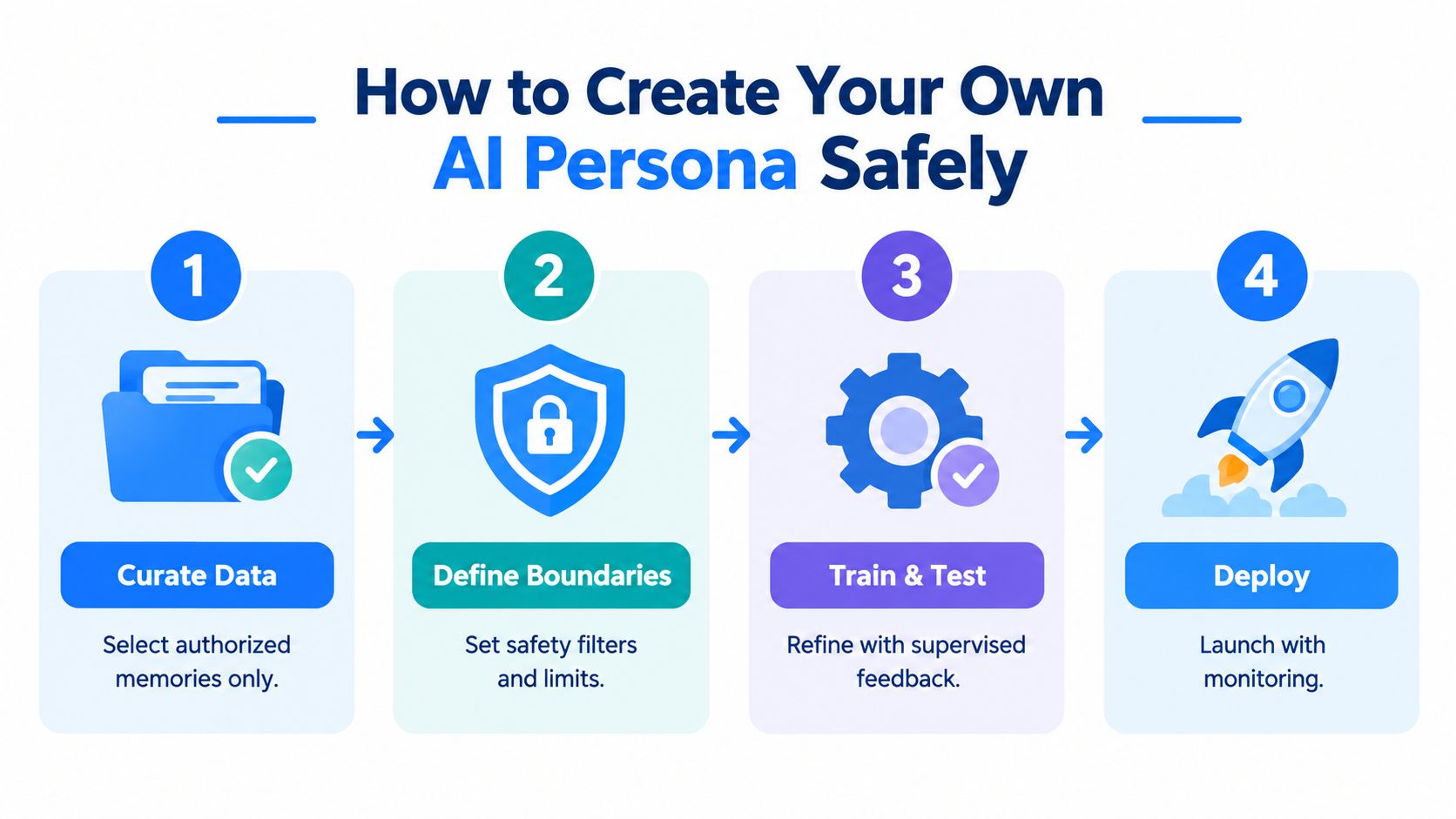
3. Review memory and inference separately
A useful persona system stores memories as records that remain inspectable. Each record should have a source, confidence, timestamp, and scope, so you can tell whether a detail came from an uploaded message or from a later interpretation.
Persona evaluation work identifies four important capabilities: anchoring facts, recalling the relevant fact, keeping answers within supplied knowledge, and expressing that knowledge naturally. In a benchmark spanning 12 language models, structured memory and retrieval prompting improved persona performance. The 8-billion-parameter Qwen3 model reached an average score of 8.12, comparable to larger closed models scoring 8.08 to 8.11. The persona-evaluation research supports a practical conclusion: model size alone isn't a sufficient quality strategy.
4. Test before trusting
Ask the persona questions with known answers, ambiguous questions, and questions outside the archive. Check whether it admits uncertainty instead of filling gaps with confident biography.
Test again after long conversations. Research using dialogues exceeding 100 rounds found that persona fidelity degrades, especially when the model must follow goals while staying in character. NIST's generative AI risk framework also emphasizes governance involving privacy, provenance, human-AI interaction, and evaluation.
A safe workflow periodically re-grounds the persona with a compact, versioned state. It retrieves authoritative memories instead of treating the entire chat transcript as truth, then checks for contradictions and missing disclosure before showing the reply.
Why People Still Have Concerns About Digital Likeness
Transparency doesn't automatically make an AI representation comfortable. People may accept a writing assistant that mirrors their tone while rejecting an avatar that simulates a hug, speaks as a deceased relative, or answers a partner's messages without disclosure.
A survey reported that 74.07% of respondents were not comfortable with AI-powered avatars of real people, while 18.52% answered “Maybe” and 7.41% answered “Yes.” The same report found that 48.15% expected these avatars to affect grieving negatively, 33.33% were unsure, 11.11% expected a positive effect, and 7.41% were neutral. The survey report shouldn't be treated as a representative worldwide estimate, but it does provide a strong directional signal about consent and emotional boundaries.
The discomfort became even clearer around simulated physical interaction. 81.48% disapproved of experiences such as an AI avatar simulating a hug or handholding, compared with 7.41% who viewed that positively, according to the same report.
Consent is broader than a checkbox
Consent must cover more than the person creating the account. A message archive may contain other people's words, photographs, private events, and identifying details. A living person may want their representation withdrawn later. Family members may disagree about memorial material, or a designated person may need authority to manage it.
A qualitative study of 25 participants found that people viewed griefbots as potentially comforting and useful for continued connection, while also raising concerns about dependency, psychological harm, inauthenticity, inequality, data use, and posthumous representation. The study on consent and post-mortem representation supports treating permission as an ongoing, revocable relationship rather than a single approval screen.
Consent should answer four questions: whose material is included, what the persona may be used for, who can inspect it, and how someone can withdraw permission.
Keep emotional boundaries visible
Memorial AI requires particular care. A conversation built from authorized messages may help someone reflect on shared stories, but it isn't a substitute for grief support or therapy. It shouldn't encourage dependence, claim certainty about the deceased, or pressure a grieving person to continue.
The same principle applies to an AI ex-partner or friend. A plausible answer about motives or past events is still generated content. Clear labels, source inspection, and a pause or deletion option give the user room to step back when the simulation becomes emotionally intense.

Data Controls, Privacy, and the Right to Delete
Uploading personal conversations creates a stewardship problem. You need to know what entered the system, which memories were derived from it, where those memories are used, and how to remove them later.
A visible chat deletion button isn't enough if uploaded messages remain in source storage or continue shaping derived persona memories. Responsible handling connects each durable memory to an authorized source and lets you correct or remove the dependent record.
Think in layers of control
Useful controls should cover the entire lifecycle:
- Source review: See which messages, photos, voice notes, and memories were included.
- Memory inspection: Open a stored fact and identify its source, scope, and confidence.
- Correction: Change an inaccurate memory instead of waiting for the model to repeat it.
- Pause: Stop persona use while preserving material for later review.
- Export: Keep a copy of the provided materials and relevant records.
- Deletion: Remove uploaded conversations and derived persona context, not only the visible chat.
ExChat describes controls for pausing, clearing conversations, exporting provided materials, and deleting derived memories. Its data controls are relevant because control needs to sit beside the memory or source it affects, not be buried far from the conversation.
Deletion should follow the source
Under Article 17 of the European Union's General Data Protection Regulation (GDPR), a person can request deletion of personal data without undue delay when the data is no longer necessary for its original purpose, consent has been withdrawn, or the person successfully objects to processing. The text of Article 17 also describes other circumstances, including unlawful processing and deletion required by law.
For an AI persona, that principle has a practical consequence. Erasing the visible chat may not address every copy or derived memory created from an uploaded conversation. A serious deletion workflow should identify dependent persona records and remove them as well, subject to the system's legal and operational responsibilities.
Privacy also involves people mentioned in your archive. Review shared conversations before uploading them, limit the persona's purpose, and avoid treating a personal history as permanent training material. The aim isn't to preserve every digital trace. It's to preserve only what you can justify, inspect, and remove.
Frequently Asked Questions About AI Personas
Is an AI version of yourself actually you?
No. It generates replies in your style from permitted messages, memories, and model inference. It isn't an actual person and can't prove what you would say.
Can I use an AI persona for memorial conversations?
You can consider memorial use only with authorized material and clear boundaries. AI isn't a substitute for grief support or therapy, and the persona doesn't bring someone back or speak with their actual thoughts.
Can I upload someone else's messages?
Only if you have the right to use them. Don't create a persona that impersonates a living person to third parties, and remove private information about people who haven't given permission.
How do I keep long-term memory accurate?
Review source-labeled memories, correct inaccurate records, remove unsupported details, and test the persona for contradictions. Treat generated inference as inference, not as a confirmed fact.
ExChat lets you create a private, clearly labeled AI persona from permitted messages, memories, and relationship context, with controls for reviewing and deleting uploaded data. If you want to explore an AI version of yourself without giving up the boundaries around your digital likeness, visit ExChat and create a persona at your own pace.
Generated with Outrank tool
Create a private, clearly labeled AI persona from conversations you are allowed to use.
Create a persona ↗