
There's a WhatsApp export sitting in your Files app. Forty thousand messages, three years of a relationship, and a quiet plan to build something private that answers in a familiar rhythm. Telegram threads look the same, and so does a folder of Instagram DMs or an old SMS backup.
Holding that file is not permission to build the person who wrote it. It's permission to read your own copy. The moment a persona replies in someone's style, the question shifts from file access to consent, and consent gets answered person by person, not upload by upload.
Most privacy law lands on one standard worth memorizing before anything else. Get that straight and the rest of the decisions get much easier.
Table of Contents
- Consent Requirements Before You Build a Persona
- Living and Memorial Personas in Everyday Chats
- The Paper Trail a Valid Consent Needs
- How to Ask for Permission and Keep the Record
- Consent Flows and Product Safeguards
- Questions to Settle Before You Create One
Consent Requirements Before You Build a Persona
Start with the version of this that goes wrong most often. Someone exports a chat, uploads the whole thing, and builds a persona that talks like their ex. Nothing about that is automatically illegal, and nothing about it is automatically fine either. The export proves you have the messages. It proves nothing about permission.
Here's the standard in plain words:
The rule in one line: permission must be freely given, specific, informed, and unambiguous, it must be as easy to withdraw as it was to give, and it never becomes a license to impersonate a living person to other people.
The European Data Protection Board's guidance for small businesses describes it that way. A person needs enough information to understand what data gets processed, why it gets processed, and how the processing works. The same guidance draws a line people blur constantly: your permission to access a conversation is not permission to present generated replies to third parties as that person. Access and identity are separate things.
The decision table worth matching before you upload
Five situations, five different answers. Read the last column first, because that's where the trouble lives.
| Persona type | Who must agree | Uses that agreement can cover | Off limits |
|---|---|---|---|
| Yourself | You, with rights to what you upload | Private style-based chat from your own messages, notes, and memories | Publishing other people's private messages without their permission |
| Living person | That person, explicitly, plus rights to the material | A private, labeled persona using only what they authorize | Impersonating them to third parties or putting them in public discovery |
| Memorial | Rights to the deceased person's archive, plus living people whose data appears in it | A labeled AI reflection on authorized stories and messages | Claiming the person is back, can be contacted, or replaces grief support |
| People inside a group chat | Each living contributor whose words, photos, or voice you keep | Only the slices those people allow | Treating possession of the export as blanket consent |
| Anyone who later sees the chat | Not a signer, but must see clear notice that replies are AI | Sharing only a labeled export that the consent policy allows | Passing generated replies off as the real person |
Row one is the easy case, since you already hold the rights to your own archive. Row two is where builders shortcut, and the shortcut fails: a friend, a cousin, or an ex cannot approve a realistic imitation on someone else's behalf. Row three takes the longest to assemble and gets its own treatment further on. Rows four and five are the ones almost nobody plans for.
What the persona is allowed to be
Whatever row you land on, the output has a fixed shape. It generates replies in a style, using context you were permitted to provide. It isn't that person, it doesn't bring anyone back, and it can't contact them. Personas of living people require that person's explicit permission plus material you have the right to use, and a realistic imitation of someone living requires explicit permission in its own right. A persona can be original, based on yourself, or inspired by another person, but only when the rights and the permission are both in place.
If you want the longer reasoning on where style ends and identity begins, the guide on whether AI can imitate a real person works through it case by case.
Living and Memorial Personas in Everyday Chats
Two projects can start from the same file and need completely different paperwork. A living-person persona needs that person's own explicit permission and material you have the right to use. A memorial persona can't get permission from the person it represents at all, so the permission has to come from somewhere else, and from more than one place.
That contrast is the whole section.
The first half of the split is settled: a living person's yes is theirs to give.
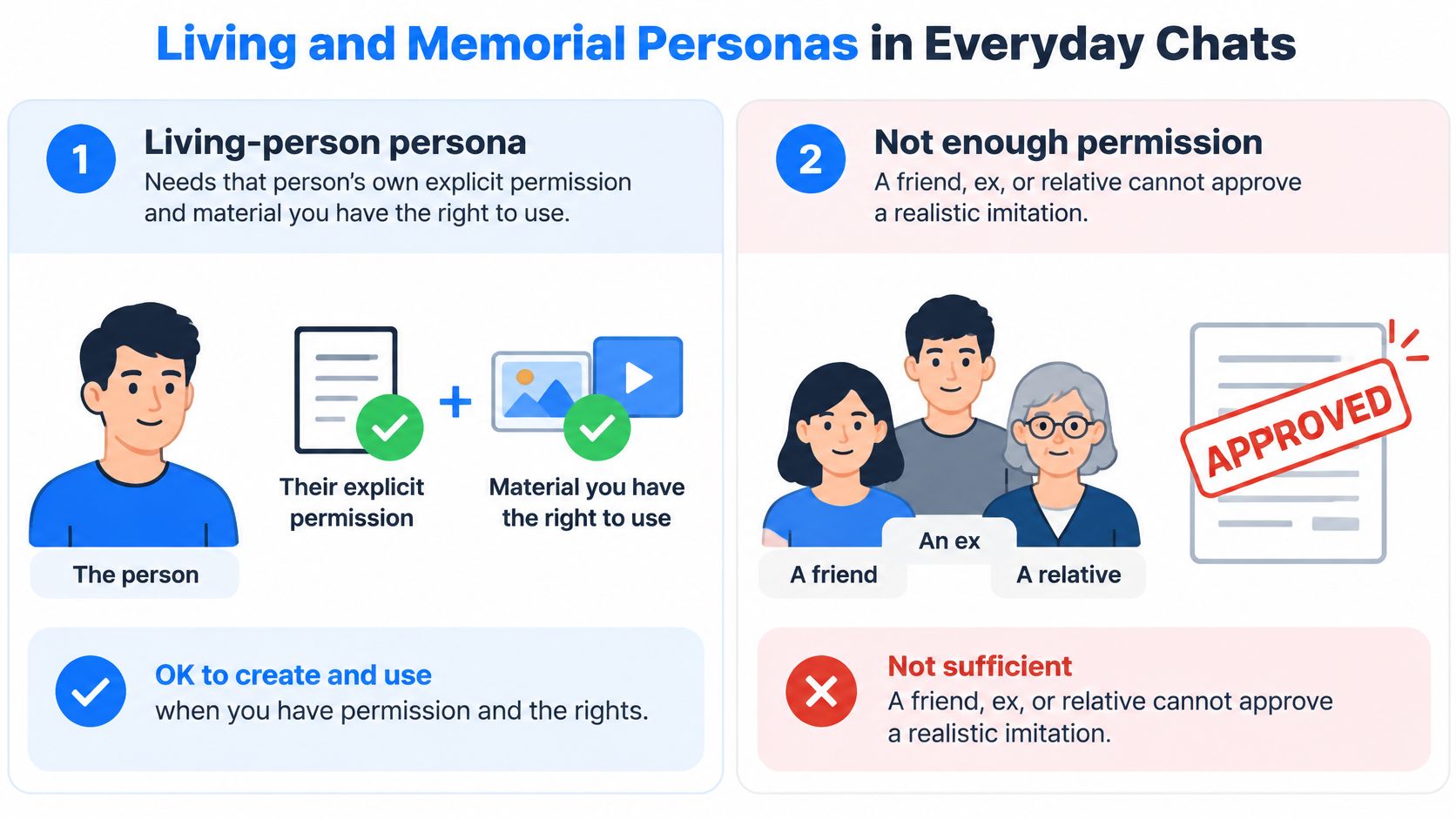
A living person's yes belongs to them
No one else can supply it. Not a partner, not a sibling, not the friend who says "she wouldn't mind." Warm approval from the people around someone is not authority over that person's words, photographs, or voice.
In practice this means a living-person persona stays private, stays labeled, and never becomes a way to contact the person or a script you hand to mutual friends as if it came from them. If the build is realistic enough to be mistaken for them, the permission has to be just as explicit.
Why a memorial is a multi-party problem
Posthumous consent is the least developed part of this field. Most guidance addresses the living person who uploads or commissions a persona, then goes quiet when the archive holds someone who has died alongside their relatives, their correspondents, and whoever took the photos.
The legal patchwork makes it worse. GDPR Recital 27 excludes deceased persons from GDPR protection while leaving safeguards to individual countries, so requirements shift across markets that otherwise look similar, as the ISACA Journal's examination of the digital afterlife industry lays out. The stronger model that piece identifies is mutual consent: authorization from the deceased where possible, consent from living people represented in relational data, and informed consent from anyone interacting with the system.
That translates into four permissions you should be able to name separately:
- Rights to the deceased person's materials, meaning you're authorized to use the messages, photos, and voice notes.
- Permission from living people who appear in them, because a group chat is a room full of contributors, not one archive.
- Authority to operate or inherit the persona, which is a different question from who may read the messages.
- A continuing right to object, restrict access, or request deletion, held by the people still here.
A shared photo album is the clearest picture. The family owns the album. Every face in it still has a say.
Family approval is the shortcut everyone reaches for, and it's weak precisely because families don't hold legal authority over every contributor's data and can't waive living people's privacy rights on their behalf. One next-of-kin checkbox records one person's comfort, not a household's consent.
Four scenes from ordinary exports
An ex's old messages. Only with that living person's explicit permission, kept private and labeled, and never used to reach out to them or handed to friends as if the replies were theirs. The relationship being over doesn't expire their privacy.
A parent's memorial built from the family group chat. Get the living relatives' yes, keep the tone caring, and present the result as an AI-generated reflection drawn from permitted material. It isn't your parent, it isn't a way to reach them, and it doesn't stand in for grief counseling or therapy.
Friends' running jokes. Use only the phrases and stories those friends have agreed to. Shared humor is joint property in the everyday sense, even when nobody has said so out loud.
Your own digital twin. The cleanest case you'll ever have, since the words are yours. Other people's lines inside your archive still need their own yes.
For memorial builds specifically, legitimate rights to the source material, careful handling of living people's privacy, and repeated AI disclosure all have to be in place together.
The California rule that makes this concrete
California gives a hard number to a soft concern. Under California Civil Code section 3344.1, producing, distributing, or making available a digital replica of a deceased personality's voice or likeness in an expressive audiovisual work or sound recording without prior consent from a person identified by the statute can create liability, and the statute sets damages at the greater of $10,000 or the actual damages suffered by whoever controls those likeness rights.
That doesn't mean every memorial chat falls under it, or that one state's rule governs every country and every medium. It means a realistic memorial voice or face is worth clearing before you build, not after. Our own consent and likeness guidelines treat it that way, and the text message persona walkthrough shows where permission gets checked during setup.
The Paper Trail a Valid Consent Needs
A checkbox records a mood. A receipt records an agreement. What you want is the receipt, because the useful question six months from now isn't "did they seem fine with it?" It's "what exactly did they say yes to, and when?"
The EU's approach to consent is a useful measuring stick, even where it isn't the law that binds you. For a persona built from messages, photos, voice notes or relationship details, treat consent as a purpose-specific, affirmative opt-in rather than something inferred from the fact that you own the source material. The record should bind the individual, the source category, the permitted uses, the retention period, the scope for training or inference, and the withdrawal status.
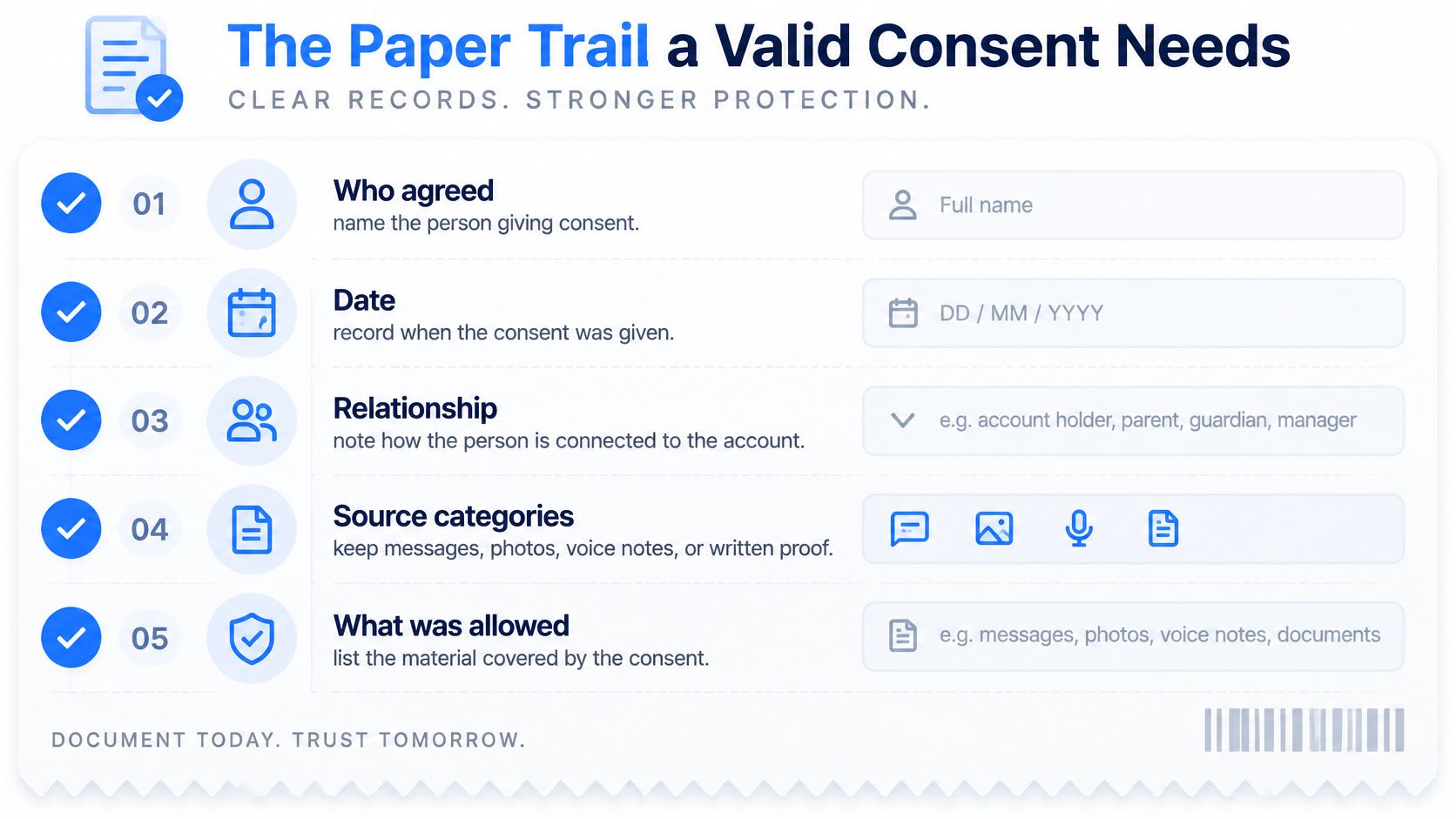
The fields worth keeping
| Field | What to record | Example |
|---|---|---|
| Who agreed | Full name and relationship to you | Jordan Lee, friend |
| Date and form | Date and the message or form used | 14 March, reply to written request |
| Sources | Category: messages, photos, voice notes, or memories | Telegram export, 40 photos, 12 voice notes |
| Permitted uses | Each approved use, listed separately | Private text-style chat only |
| Retention | How long the material is kept | A fixed end date you both agree on |
| Memory and training scope | Whether it shapes memory or only one chat | Single chat, no shared memory |
| Withdrawal status | Date and method of any withdrawal | Open, none recorded |
One row per agreeing person. A memorial build makes that obvious: the archive may come from one family member while the person it depicts is gone and can't sign anything, so the record has to name who holds the rights to the material and which living people inside it gave their own yes. A group chat export can hold a dozen authors, and each one is a separate line, a separate scope, and a separate withdrawal to track later.
The stakes behind the paperwork are real. Under the GDPR, certain infringements can carry fines of up to €20 million or 4% of a company's worldwide annual turnover, whichever is higher, according to the EU's data protection guidance for businesses. That's the environment a platform operates in, which is why the consent event needs to be auditable rather than remembered.
Purpose doesn't travel
The most common misunderstanding: a yes covers the project you described. The project you later get excited about is a different matter. Reusing an archive that was supplied for private conversation reconstruction to build a public-facing persona, generate a realistic avatar, synthesize a voice, or share outputs is a new or expanded purpose, and it needs separate authorization.
Sensitive details raise the bar again. If the messages reveal health information, biometric data, racial or religious detail, or sexual orientation, ordinary permission may not be enough, and the safest move is to keep that material out unless a separate, explicit yes exists.
Alongside consent sit the account basics: you meet the age requirement, your account information is accurate, you hold the rights to what you upload, and you follow acceptable use rules. Treat those as the floor. Consent builds on top of them.
Good looks like this: someone else could read your record, understand what was allowed and what wasn't, and see how to undo it. Everything you provided stays inspectable and removable from your data controls rather than buried in a support queue.
How to Ask for Permission and Keep the Record
The ask takes about ten minutes and saves months of second-guessing. Do it in writing, so the other person can reread it and so you have something to point to later.
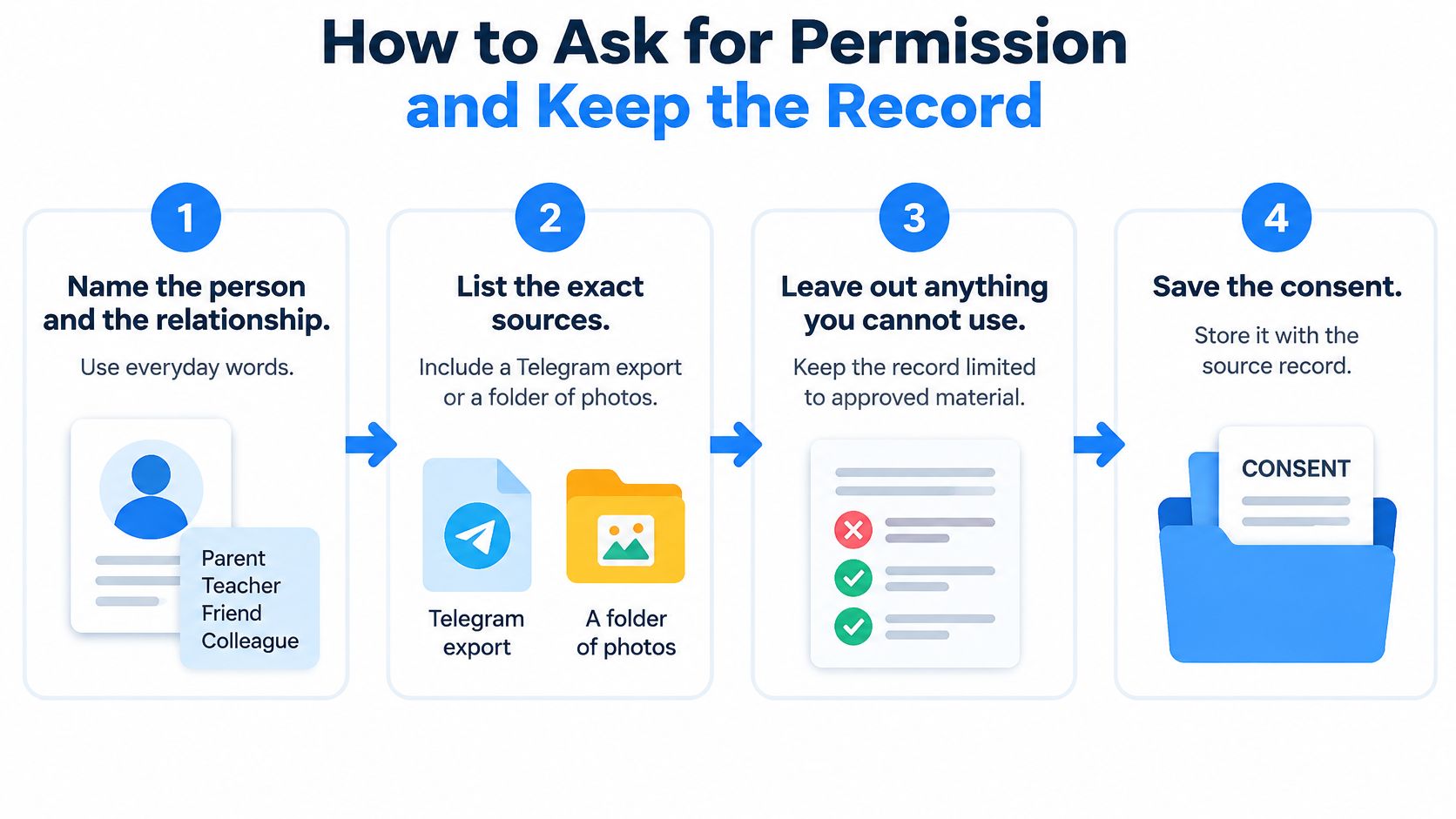
Name the person and the relationship in everyday words. "You, my sister" beats "the data subject." The reason: the person needs to recognize themselves in the request. The slip: vague framing that leaves them unsure whether they're agreeing to a chat or to a public likeness.
List the exact sources. A Telegram export, a folder of 30 photos, a set of voice notes. The reason: scope is what they're agreeing to. The slip: "some old messages," which covers everything and therefore nothing.
State the purpose in one sentence. A private, clearly labeled AI persona that generates replies in their style from the material they approved. If you can't fit it in a sentence, the plan is too sprawling to consent to.
Say the nos up front. No pretending to be them with other people, no public listing, no claim that the chat is really them. The reason: people agree faster when the boundaries are visible. The slip: burying limits in a wall of text nobody reads.
Ask for a clear affirmative yes. A reply or a short form they can keep. Silence, an old friendly chat, or a pre-ticked box doesn't count as agreement.
Save who agreed, when, what scope, and how to take it back. One message, one date, one list. Withdrawal should be as easy as the original yes, with no penalty attached.
Ask again when the use grows. Adding voice, a more realistic avatar, or any kind of sharing is a fresh request, not an extension of the first one.
Where this fits into the build
Setup runs in four steps: Define, Add, Review, and Talk. Relationship context, personality, tone, and boundaries come first in Define. In Add, you provide stories, notes, and supported messages that you have the right to use, which is exactly why the ask above should name your sources before you start. Review happens before the first message, so you can see what the persona will draw on.
The import paths each carry their own material: WhatsApp chat imports, Telegram exports, and Instagram message archives. The four-step setup guide shows the same sequence with the screens attached.
Consent Flows and Product Safeguards
Permission is a conversation. Disclosure is a property of the interface. They don't substitute for each other, and a product needs both.
What the screen should do before the first reply
A workable flow asks for a purpose-specific opt-in before any upload, shows the sources about to be used, and requires approval before the persona sends its first message. Labels stay visible in the thread, on the avatar, and again when content leaves the app.
The EU AI Act treats that as a separate obligation from consent. Its transparency framework requires deployers of systems that generate or manipulate deepfake image, audio, or video content to disclose that the content is artificially generated or manipulated, and Article 50 of the EU AI Act adds that the disclosure has to be clear, distinguishable, understandable, and perceivable without special tools, at the latest when someone is first exposed to the content.
Voice raises the stakes again. Illinois biometric privacy rules require informed consent before biometric data is processed and limit retention to three years, as Reed Smith's 2025 biometric compliance update reports. Synthesized voice moves a persona into that territory quickly.
The test that matters: hand someone a screenshot mid-conversation. If they can't tell a provided message from a model inference, the labeling has failed, even if every permission was signed.
The controls that must survive onboarding
Boundaries belong in the same flow as consent. Set the topics the persona should decline, the facts it should not invent, and the behaviors it must never perform, and keep real-person and memory personas out of public discovery and search, with sharing limited by the consent policy. Sensitive material stays private by default.
After the chat starts, the person needs inspect, correct, clear, pause, export, and delete for both sources and derived memories. Deleting a file should also cover the indexes and derived memories a product says it removes, not only the original upload. None of that should require a payment: reporting, AI disclosure, core data controls, deletion, and crisis resources stay outside the paid tier.
Questions to Settle Before You Create One
Four things people ask after they've read the rules and before they upload anything.
What if I'm not sure my country allows this?
Skip realistic likenesses and synthesized voices, keep living people's material out unless you have their explicit permission, and use only sources you could defend out loud to the people who appear in them. For a memorial build or voice replica, talk to a qualified local adviser first. Rules differ by country, and a confident guess is no defense. Remember that a family archive is rarely single-author: the group chat that documents a grandmother's last year also holds her living grandchildren's words, and their privacy rights travel with the export.
What happens to a persona if I delete a source file?
Deletion removes the source and the derived memories built from it under the published retention process, not only the original upload. Before you delete, open the memory inspection view and check which entries trace back to that file, so the result matches what you expected. The same controls let you correct context, clear a conversation, pause the persona, or export your material first, and none of it requires contacting support.
Can I share a persona with friends or family?
Only as a labeled export that your consent policy allows, and only for material everyone appearing in it has agreed to. Sharing an unlabeled transcript is how a private reflection turns into someone else's misinformation. A memorial persona that quotes a living sibling's messages needs that sibling's yes too; the person being remembered cannot grant it for them.
What if someone in the chat asks to be removed?
Treat it as withdrawal, not a negotiation. Stop using their material, delete what you hold, and record the date and method. Their messages may sit inside someone else's export, so check the derived memories as well as the file itself. That's the continuing right to object doing its job.
If the conversations you want to build from are ones you're clearly allowed to use, ExChat lets you turn them into a private, visibly labeled persona, review every input before the first message, and keep deletion in your own hands. Start with a person's explicit yes, describe the use plainly, and let the product carry the disclosure and the controls from there. You can begin at ExChat; plan details are set to be published alongside final billing and limits.
Create a private, clearly labeled AI persona from conversations you are allowed to use.
Create a persona ↗