

You're scrolling through an old WhatsApp conversation, looking for a phrase someone always used. You recognize it when you find it, but you couldn't have recalled it without looking. If you're building an AI persona from those messages, another question follows: which details should it carry into future conversations?
Learning how to train long term memory starts with a manageable loop: save, test, correct, and delete what shouldn't stay. For people, spaced recall can strengthen learning. For an AI persona, the same review routine helps you check its answers and improve its source material. Those are different mechanisms, though. Asking a persona questions doesn't prove that it learns biologically or that every chat retrains its underlying model.
Table of Contents
- Consent Rules Before You Use Anyone Else's Messages
- Choosing Which Memories Are Worth Keeping
- How to Write and Label Each Memory
- A Review Schedule That Makes Memories Stick
- Testing Recall and Fixing Errors in Chat
- Editing, Pausing and Deleting Memories Safely
- Frequently Asked Questions About Long Term Memory
- Start Your First Memory Set on ExChat
Consent Rules Before You Use Anyone Else's Messages
Only use conversations you have the right to use, and never present a persona built from someone else's messages as that person to a third party.
Having a chat export on your phone isn't the same as having permission to use everyone's words for an AI persona. Under the European Commission's GDPR guidance, consent must be freely given, specific, informed, and unambiguous, tied to stated purposes; people can withdraw it and, in qualifying circumstances, request deletion.
Keep that boundary in mind before selecting an archive.
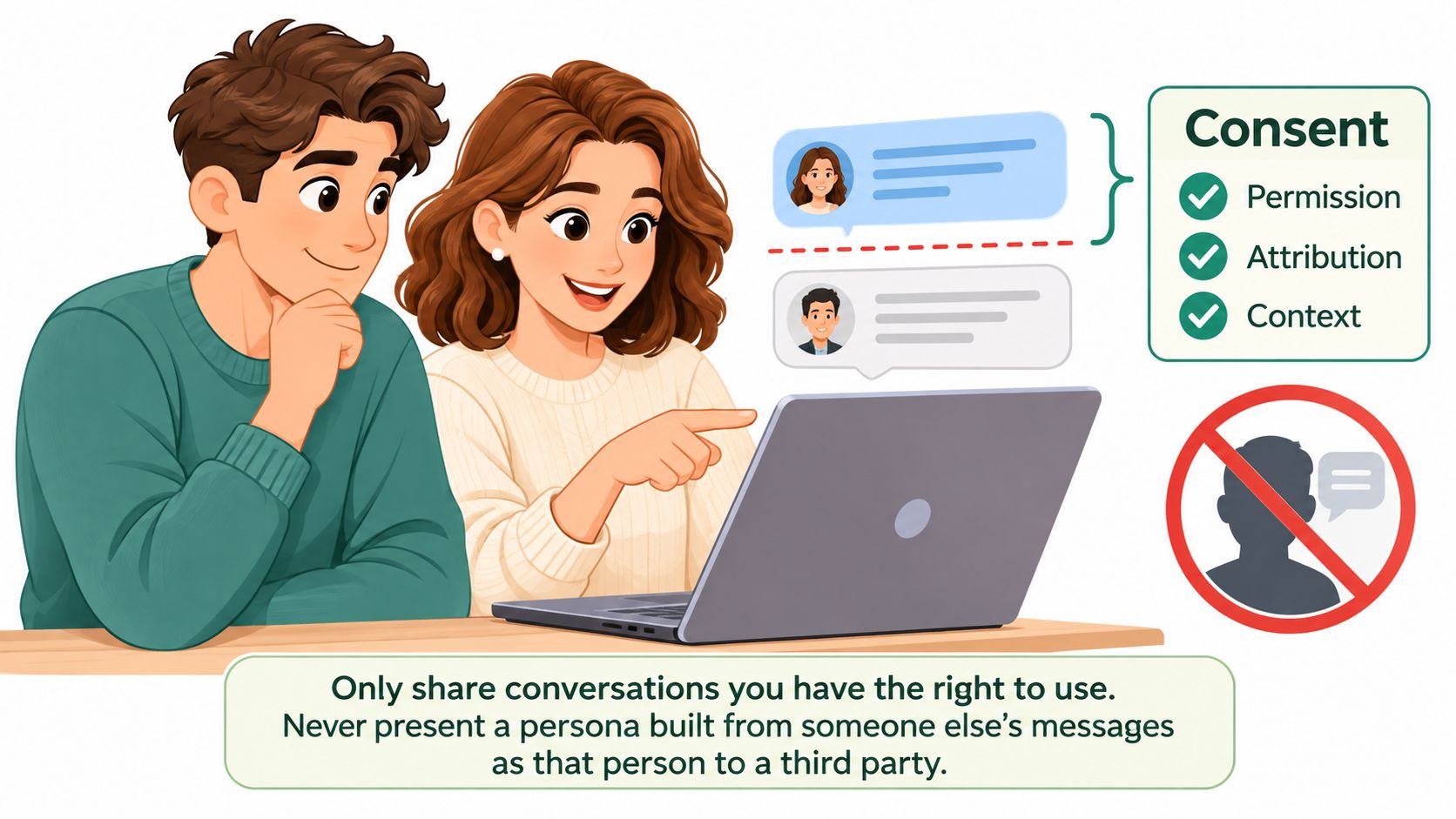
Check permission before uploading
- Who appears in these messages? Look beyond the main participants for forwarded messages, names, photos, and private details about others.
- Did each person agree to this use? Explain the intended persona rather than asking for vague permission to use their data.
- Can you delete this material later? Keep source files identifiable so you can find and remove them.
- Will the persona stay clearly labeled as AI? Keep the disclosure visible, including whenever permitted sharing occurs.
If permission, deletion, or disclosure isn't in place, leave that conversation out. Our consent and likeness rules set the boundaries for permitted use. Real-person and memory personas shouldn't appear in public discovery or search, and sharing is limited by the consent policy.
Privacy boundary: Being part of a conversation doesn't automatically authorize every later use of it.
For memorial use, legitimate rights to the material, protection of living people's privacy, and repeated AI disclosure remain necessary. A memorial AI persona is for reflection and remembrance, not resurrection. It isn't the person, and it isn't a substitute for grief counseling, therapy, or human support when grief feels heavy.
Choosing Which Memories Are Worth Keeping
- Recurring: The detail appears across messages, rather than in a passing remark.
- Concrete: It includes a recognizable name, place, date, phrase, or story.
- Useful later: It preserves a preference, boundary, shared joke, or fact you want to recall.
- Permitted: You have the right to use the material for this purpose.
Treat permission as mandatory, not a point that other strengths can outweigh. After that, choose details that serve a clear purpose. A relationship memory set might preserve shared expressions; a personal learning set might contain concepts you need for work.
Skip expired logistics, such as an old flight time. Leave out sensitive third-party details and guesses disguised as facts. If you're unsure whether someone disliked a restaurant or had a bad evening there, don't store a permanent preference.
Select for the outcome you want
A persona can draw on relationship context, memories, inside jokes, personality details, and optional permitted messages. You don't need to supply an entire archive to make those choices meaningful. The guide to creating an AI clone from text messages explains input selection.
Human memory training also benefits from a clear target. A preregistered, double-blind study of working-memory training found no near- or far-transfer effects, even when longer training improved performance on practiced tasks. Don't assume that getting better at a game means you'll remember conversations or understand reading better.
Try this hypothetical filter: start with 20 candidate memories, then keep 8 to 12 that satisfy at least three criteria, always including permission. Write a line explaining why each stays.
A grandmother's recurring phrase that you still use passes recurrence, concreteness, and usefulness, provided its use is authorized. An expired dentist reminder may be concrete, but it doesn't belong in this lasting memory set. The aim isn't maximum storage. It's a set worth checking.
How to Write and Label Each Memory
A useful entry lets you distinguish what happened, where the information came from, and what you're interpreting. Write it so someone checking an answer won't need to reconstruct the entire conversation.
Use this visual as a cue-writing checklist.
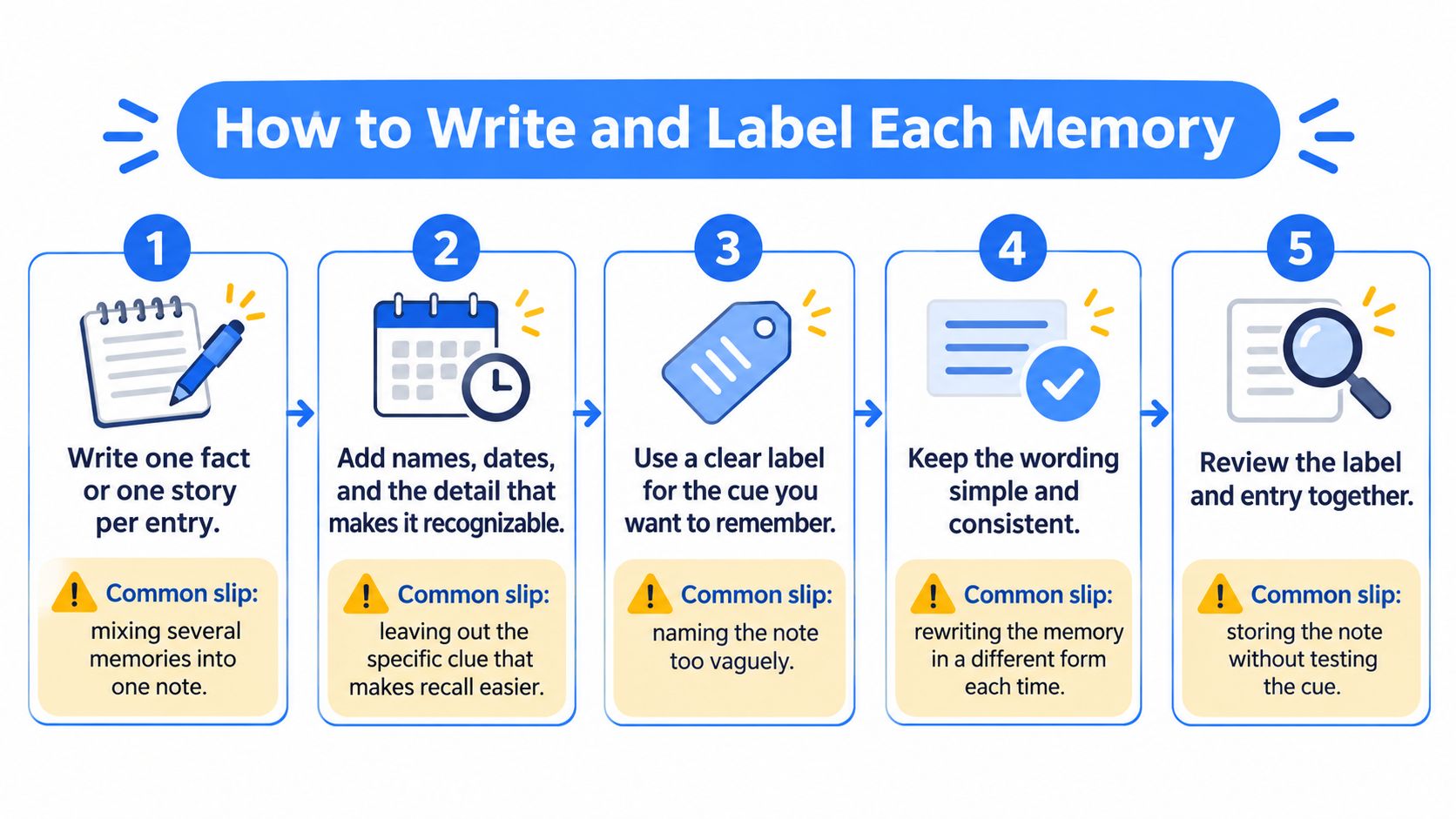
Build entries you can trace
Write one fact or one story per entry. Include names, dates when known, and the detail that makes it recognizable. Common slip: Mixing several memories into one note, making later answers harder to check.
Add a source label. Mark the entry as an imported message, a memory you added, or an inference you made. Common slip: Treating your interpretation as though someone stated it directly.
Add a context line. Say who was involved, when it happened, and why it matters; give the entry a clear cue such as Rainy picnic at Lake Park. Common slip: Leaving out the significance or using a vague title such as Nice day.
Mark the core entries. Prioritize central facts and recurring expressions, and keep their wording simple and consistent. Common slip: Marking everything as important or rewriting it differently at every review.
Save, then check later. Leave the set alone for a few hours before testing the label and entry together. Common slip: Reading it immediately and mistaking freshness for durable recall.
For example, write: Added memory: Maya called our rainy Lake Park picnic an indoor picnic with extra steps. Context: a shared joke about adapting plans. Don't add a date you can't verify or broaden the joke into a claim that Maya loved bad weather.
Give yourself a quiet pause
A systematic review and meta-analysis of wakeful rest found that rest after learning improved memory consolidation. Try sitting or taking a walk without adding a podcast, scrolling, or unrelated demanding work. Rest complements later recall; it doesn't replace it.
This accompanying video offers another way to approach memory practice.
As a practical writing target, make each entry readable in about ten seconds. You should be able to explain what it says, where it came from, and why you stored it. In our workflow, a reply can point back to an imported message, an added memory, or an AI inference, and you can correct or delete that source.
A Review Schedule That Makes Memories Stick
After saving a memory, you might recall it easily that afternoon and struggle with it a week later. A review schedule helps you notice that difference. Start with a small set, such as a relationship detail, a recurring phrase, or a work fact, and prepare a few questions before reviewing.
The schedule below is a practical starting point, not a prescription that works for every person or every memory.
Review schedule for a new memory set
| Review point | Timing | Task | Pass signal |
|---|---|---|---|
| First review | Same day, 2–4 hours after saving | Answer 3 questions about the set without notes | All 3 answers correct |
| Second review | Day 2 or 3 | Ask the same questions in a new order | At least 2 of 3 correct |
| Third review | Day 7 | Add one new cue to each memory and recall it | Specific answer with no hint |
| Spot check | Day 21–30 | Recall 5 random memories | All 5 recalled unaided |
| Any miss | Retry in 1–2 days | Retry only the missed items | Correct on the retry |
Close your notes before answering the first set of questions. On the next review, shuffle the order so that remembering the sequence cannot carry you. A partial pass is useful feedback: keep the missed item in the rotation rather than treating the whole set as mastered.
At the later review, change the cue. Instead of asking which park hosted the picnic, ask what happened when rain interrupted the plan. A different question is like approaching a familiar room from another doorway. It checks whether the memory is accessible beyond one rehearsed prompt.
Judge the delayed answer
In a controlled study of drug brand and generic names, spaced practice produced better retention after a six-week delay than massed practice. The study supports leaving time between reviews, but it does not establish the exact calendar above.
Use the schedule as a starting point and adjust it when recall is difficult.
An immediate pass tells you that you can answer now. A delayed check tells you more about what remains accessible.
A correct answer at the week-later check is encouraging, not a lifetime guarantee. If you miss one, shorten the gap before trying again. The same spacing idea can guide persona audits: ask questions in chat at intervals and compare replies with their source entries. Repeated questioning does not, by itself, strengthen an AI's memory.
Testing Recall and Fixing Errors in Chat
A 2013 review by John Dunlosky and colleagues evaluated 10 learning techniques and rated practice testing and distributed practice as the only methods with high overall utility. Practice testing means retrieving an answer rather than rereading it; distributed practice means spreading learning across time.
For your own learning, attempt an answer before opening the note. For a persona, ask questions instead of merely scanning its memory list. The first activity exercises human retrieval; the second tests whether generated replies match permitted context.
Use different kinds of questions
Build a test set with these three jobs:
- Direct recall: Ask something a single entry answers, such as where the rainy picnic happened.
- Combined cues: Ask something that requires separate entries, such as connecting the picnic story with a documented phrase.
- A deliberate unknown: Ask about something absent from the set, such as what everyone ordered afterward.
Ask each in a fresh chat to reduce clues from preceding messages. Compare the answer with the source, not with how natural or affectionate it sounds. For the unknown, a useful answer acknowledges that the information isn't available.
Memory symptoms, causes and fixes
| Symptom | Likely cause | Fix |
|---|---|---|
| Wrong detail in a reply | Misread source or wrong date | Open the entry, correct the detail, then retest |
| Two memories blended into one answer | Entry covers too many facts | Split the entry so each holds one fact |
| Plausible detail that is in no memory | Inference filling a gap | Check the label, then delete the inference or add the real detail |
| Right answer, wrong voice | Tone note too vague | Rewrite the context line with sample phrases |
| Item forgotten after several weeks | Missed review point | Put the item back on the review schedule |
Treat these as starting diagnoses, not proof of a cause. A human learner may need another retrieval attempt; a persona may need a clearer source entry, corrected context, or removal of an unsupported inference.
Our Review step lets you preview replies, inspect source memories, correct inaccuracies, and remove unwanted information before a longer conversation. The AI can misunderstand a source, combine memories incorrectly, or invent a plausible detail, which is why important context stays editable.
Don't rewrite a source just to make a test pass. Preserve the original meaning, then retest the corrected entry. For human learning, keep practicing until each item is correctly recalled at least once rather than stopping at familiarity. For the persona, a correct result is a useful check, not a guarantee against future mistakes.
Editing, Pausing and Deleting Memories Safely
Memory actions compared
| Action | What it changes | Use it when |
|---|---|---|
| Correct an entry | Rewrites the wrong detail in your own notes | A detail is wrong or outdated |
| Split an entry | Separates a broad entry into single facts | Two facts are blended in replies |
| Retire an entry | Takes it out of the set you test and load | You want it out of play for now |
| Delete the source | Removes the original uploaded message or file | The material should no longer be used |
| Delete your uploaded data | Removes the data you supplied | You want to stop using the persona entirely |
Keep an entry when it remains accurate, useful, and permitted. Correct a mistaken date without embellishing the story. Split an entry when unrelated facts keep appearing together, and retire material when you're unsure whether it still belongs.
Retiring is a working-set decision, not a promise of erasure. Likewise, clearing a conversation isn't interchangeable with deleting its source material.
Know what deletion covers
The UK Information Commissioner's Office guidance on AI and individual rights says organizations should consider requests to erase personal data from AI training data, while noting that erasing training data doesn't automatically require deleting every model derived from it.
A source message, a derived memory, and an underlying model are separate things. Don't assume a control affecting one necessarily removes all the others.
In our workflow, you can open, edit, pin, or remove a memory from future conversations. Corrections change what the persona uses next. You can also inspect context, clear a conversation, pause the persona, export your material, and delete sources and derived information according to the retention process.
Maintenance habit: Keep useful context current, and remove material when permission or purpose no longer holds.
Our final data retention schedule will be published before launch. Check the data controls page before relying on deletion timing.
As a monthly routine, review frequently used entries, retire stale material, and keep an authorized copy of the set you still use in your own files. Don't retain a backup of material you no longer have permission to keep.
Frequently Asked Questions About Long Term Memory
1. How long does it take to train long-term memory?
There's no fixed timeline. The suggested routine runs through a spot check about 21 to 30 days after saving, but that's a planning window, not a promise that learning will be finished.
Judge progress by delayed, unaided recall. If you miss an item, correct it and bring it back sooner rather than restarting the entire set.
2. Do brain-training games improve memory?
They can improve performance on the tasks you practice, but you shouldn't assume those gains transfer to everyday learning or reading comprehension. A higher game score isn't the same outcome as remembering a conversation or explaining something you read.
Choose a real target, then check it directly. Remembering the information you need is a more useful measure than accumulating training time.
3. Does an ExChat persona remember the way the real person did?
No. It's a private, clearly labeled AI persona that generates replies in the style of the material you supplied. It isn't the person and can't contact them or anyone else.
A fluent response also isn't evidence that an event happened. Check the source when an answer adds a detail, especially one that changes the meaning of a shared story.
4. What if I'm grieving and using a memorial persona?
Use it for reflection only, and give yourself permission to pause if it feels unsettling or makes daily life harder. You don't need to continue because you invested time in creating it.
It isn't a substitute for grief counseling or therapy. Human support matters more when grief is heavy, whether that means someone you trust, a grief group, or a qualified professional.
Start Your First Memory Set on ExChat
Start with material you can check comfortably, not the largest archive you can export. A small set makes it easier to notice an unsupported detail and decide whether a memory belongs at all.
Follow the creation flow
- Upload permitted material. Choose the chats, photos, voice notes, and memories you have the right to use. Leave out uncertain permissions and unrelated third-party details.
- Review the persona. Ask your test questions, inspect the sources behind replies, and correct wrong details before beginning a longer exchange.
- Start a private chat. The conversation stays clearly labeled as AI. Keep that distinction visible even when the wording feels familiar.
The how-it-works guide explains the full flow. For preparing your chosen archive, use the guides for WhatsApp messages, Telegram messages, or Instagram messages.
Keep the first set small
As a starting exercise, choose about ten memories using the permission, relevance, and specificity criteria. Give each an identifiable source and a question you can answer from it. Run the day-two-or-three check before adding more.
If the answers are inconsistent, improve the entries instead of expanding the archive. More material won't automatically resolve ambiguous wording or an unsupported assumption.
For plan details, check pricing. Upgrading is the option if you need more memory, but first make sure the set you already have is accurate and useful.
ExChat creates private, clearly labeled AI personas from permitted messages, memories, and relationship context, with uploaded data you control and can delete. When you're ready, visit ExChat to create a persona and begin with a small, checkable memory set rather than a whole archive.
Create a private, clearly labeled AI persona from conversations you are allowed to use.
Create a persona ↗